 ⬇️
⬇️
Key Takeaways
- Alphabet and Tesla quarterly results pulled US equities lower in extended trading
- ASX 200 futures rose 0.8% as local markets prepared for Australia’s June labour report
- Nvidia’s rebound and rising oil prices added new tension to already tech-heavy global positioning
Australian equities look set for a firmer open after a choppy US session that turned on two familiar names: Alphabet and Tesla. Both companies delivered earnings that traders dissected line by line, and the initial reaction was cool. Extended trading saw each fall about 3%, a shift that mattered because global equity indices remain unusually concentrated in a handful of mega-cap technology stocks. Information technology and communication services now represent more than 35% of S&P 500 market capitalization, according to S&P Dow Jones Indices analysis cited earlier this year. When Alphabet or Tesla stumble, even slightly, the impact radiates outward.
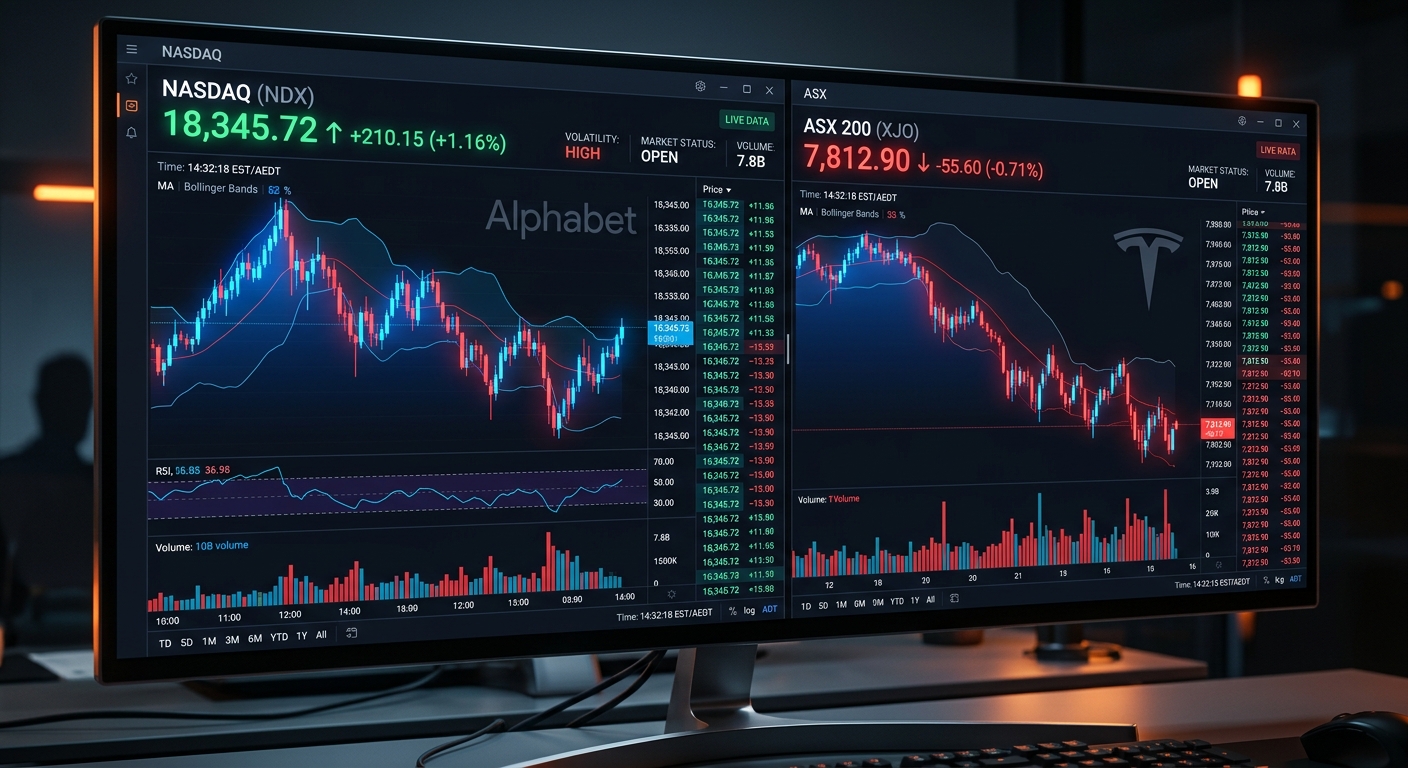
ASX 200 futures pointed 72 points higher to 8839, or roughly 0.8%, suggesting Australian investors are weighing the overnight tech wobble against today’s domestic labour market release. The June jobs report drops mid-morning, and it tends to be one of the local market’s more reactive data points. This is partly structural. Over the past five years, daily return correlations between the S&P 500 and the S&P/ASX 200 have averaged about 0.6, a figure frequently referenced by MSCI researchers. So even modest US moves can set the tone in Australia.
A mixed US session did not help. The S&P 500 finished down 0.1%, dragged by communication services. A late rally in chipmakers added some resilience. Key listed vendors shaping this narrative include Intel and Nvidia, whose trajectories make the broader tech narrative slightly more complicated. Market participants are left to evaluate whether the softness in Alphabet and Tesla was idiosyncratic, or if investors are pausing after an extraordinary multi-quarter run in AI and EV names.
Investors will likely debate that question throughout the week. Alphabet’s update showed stronger-than-expected cloud revenue alongside some softness around search and margin performance. Tesla’s results underscored the ongoing evaluation of EV growth momentum. When a stock with enormous retail and institutional ownership experiences friction, the market takes notice. Tesla’s trajectory matters for Australian investors too, because it is one of the most widely traded offshore equities among self-managed super funds.
Market participants also kept an eye on IBM, which edged higher amid shifting tech narratives. The company had already absorbed previous downgrades, allowing incremental news to land without major disruption.
Crude oil edged higher as the United States and Iran continued to exchange political pressure. Rising oil adds a layer of uncertainty for central banks already cautious about inflation trajectories. Gold, often a beneficiary of this unease, also attracted investor attention.
Market movements point to a complex environment with varying performance across digital assets like bitcoin, commodities such as iron ore, and volatility indices like the VIX. Taken together, the figures highlight a market trying to price several macro levers at once. One of the more important is US labour momentum. The US nonfarm payrolls report showed June added 57,000 jobs, roughly half of the 110,000 economists expected, according to data reported by Reuters. Lower job creation shifts attention back to the Federal Reserve’s dual mandate and the Fed’s sensitivity to cooling labour demand.
Australian forecasters are split on how the local labour numbers might land. Analysts at NAB highlight recent volatility as mostly holiday timing effects, while TD evaluates the potential for participation shifts. Either way, both see the Reserve Bank of Australia in a wait-and-see posture given easing oil prices earlier in the quarter and slowing economic activity.
A question some portfolio managers may be asking is whether the ASX can maintain upward momentum if US tech earnings continue to deliver mixed signals. The weight of global institutional capital tends to mean international catalysts often overshadow domestic ones. McKinsey Global Institute has noted that listed equities account for over half of the $42 trillion in global equity assets under management. In practice, that scale turns events like Alphabet’s cloud performance or Tesla’s earnings into cross-market drivers.
Not everything on the radar is strictly financial. Canberra continues to digest security concerns after an AI incident involving OpenAI and scrutiny of models such as Kimi K3. The debate shows how interconnected technology, regulation, and market confidence have become. A surprise in the regulatory space can now influence sentiment almost as fast as an earnings miss.
By late afternoon, the European Central Bank’s expected steady-rates decision also sat in the background. Investors tend to treat ECB holds as a mild stabiliser, although not a major catalyst for Australian equities. Still, on days packed with data, even small constants can shape how traders position before the close.
High-concentration tech leadership, labour market crosscurrents, and shifting geopolitical signals now interact in real time to capture the push-pull nature of global markets. Australian traders have become adept at navigating these crosswinds. Whether the ASX follows futures higher will depend on how all these threads come together when the opening bell rings.