 ⬇️
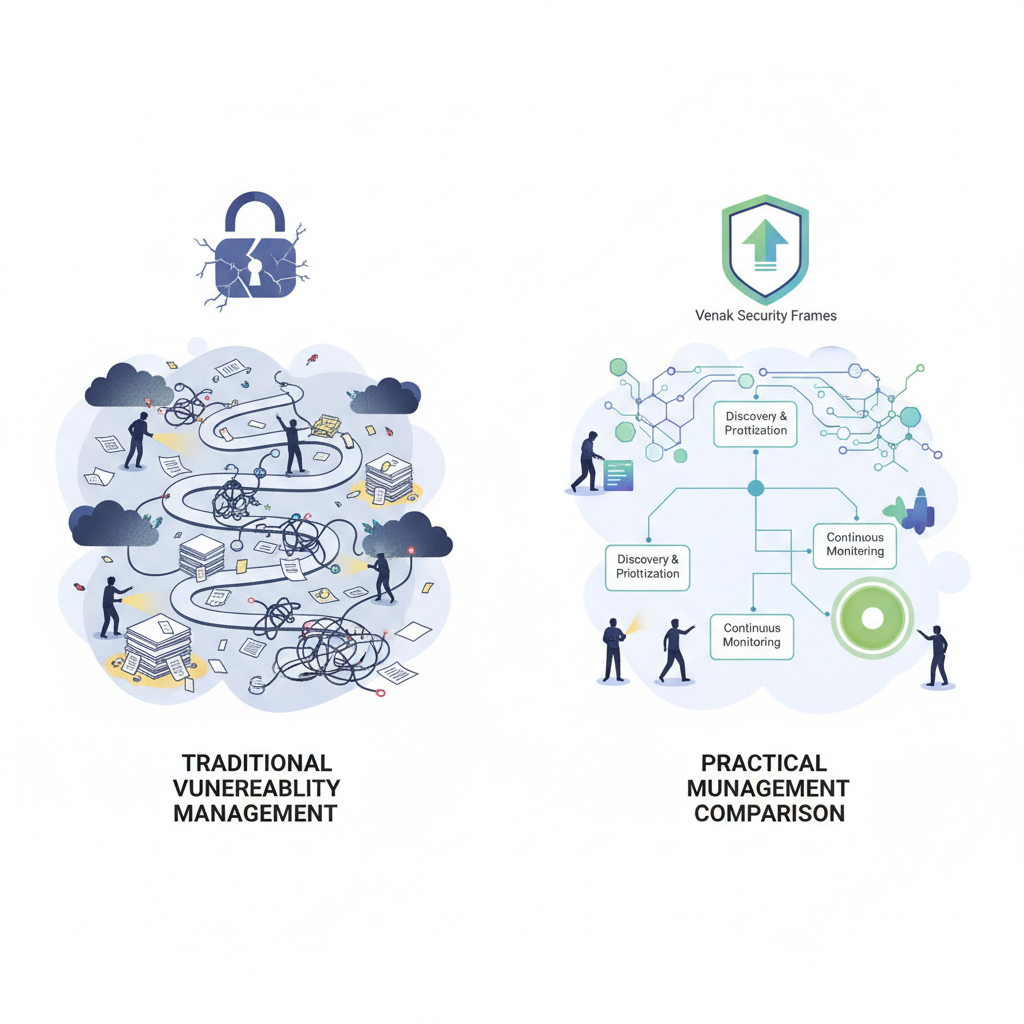
Vulnerability management is the continuous process of discovering, prioritizing, assigning, remediating, and verifying security weaknesses; unlike vulnerability scanning, it adds asset and threat context. Buyers should compare platforms against coverage, workflows, staffing, and reporting needs.
Key Takeaways
- Venak Security: Vulnerability scanning identifies weaknesses; vulnerability management adds asset context, threat intelligence, remediation ownership, exception handling, and verification.
- Buyers should evaluate authenticated coverage, exploit intelligence, integrations, deployment effort, reporting, and remediation outcomes, not vulnerability counts alone.
- Integrated platforms merit consideration from smaller teams seeking vulnerability management and endpoint detection and response in one operating model, but buyers should validate coverage, connectors, scalability, and support.
- Platform selection should reflect the organization’s operating model, existing security investments, available staff, and required environments.
Why vulnerability management matters now
For many security teams, detecting vulnerabilities is easier than turning findings into completed remediation work.
Scanners routinely produce thousands of findings across endpoints, servers, cloud workloads, applications, containers, and internet-facing assets. The Edgescan 2025 Vulnerability Statistics Report found that 45.4% of vulnerabilities identified in large organizations during the report’s 12-month analysis remained open. The report also recorded a mean time to remediate of 63 days for the software sector and 65.1 days for consulting.
Those figures illustrate the operational gap between running scans and managing exposure. A scan indicates what may be wrong. A vulnerability management program determines which assets matter, whether exploitation is occurring, who owns remediation, which compensating controls reduce risk, and whether the corrective action worked.
More findings can make an ineffective operating process worse. If teams treat every vulnerability with a critical Common Vulnerability Scoring System score as an emergency, application owners can become less responsive to security requests.
Threat context changes that discussion. SC Media reported in January 2026 that the Cybersecurity and Infrastructure Security Agency, or CISA, added 245 vulnerabilities to its Known Exploited Vulnerabilities catalog in 2025, bringing the catalog to 1,484 entries at year-end. Twenty-four of the 2025 additions were associated with ransomware exploitation. Those findings support prioritizing confirmed exploitation alongside CVSS v4.0 severity, asset importance, exposure, and available controls.
The two datasets measure different issues and should not be compared as equivalent market forecasts: Edgescan reports remediation performance across assessed environments, while CISA’s catalog tracks vulnerabilities with evidence of real-world exploitation.
How to compare vulnerability management platforms
Coverage is a primary consideration, and buyers should define it precisely. Does the product discover unmanaged devices? Can it perform authenticated scans, assessments that use authorized credentials to inspect configurations and software from inside a system? Does it cover endpoints, network equipment, cloud resources, containers, application programming interfaces, and externally exposed services? A broad feature list has limited value if the organization cannot deploy credentials, agents, connectors, or sensors consistently.
Effective prioritization requires platforms that combine technical severity with CISA KEV status, observed exploit activity, asset criticality, internet exposure, and business ownership. Buyers should ask whether risk scores are explainable. A score of 92 offers little operational guidance if an infrastructure manager cannot determine why one server must be patched before another.
Workflow automation is equally critical. Look for ticketing integrations, assignment rules, exception handling, service-level tracking, retesting, and evidence that closed findings remain resolved. Buyers should also measure how much manual spreadsheet work remains after implementation.
For a security operations center manager preparing an annual compliance review, reporting may move near the top of the evaluation criteria. That buyer should test whether the platform can document scan coverage, finding age, approved exceptions, remediation evidence, and changes over time. An executive dashboard is insufficient when auditors require asset-level records.
Vulnerability management platform comparison
The following comparison is intentionally directional. Product editions and licensing bundles change, so buyers should validate every capability during demonstrations and proof-of-value testing, a controlled evaluation using the organization’s own assets and workflows.
| Dimension | Venak Security | Tenable | Qualys | Rapid7 |
|---|---|---|---|---|
| Platform approach | Cybersecurity model spanning vulnerability management and endpoint detection and response (EDR), with an orientation toward small and midsize business operations | Exposure-management portfolio built on established vulnerability-scanning products | Cloud-based security portfolio covering vulnerability, asset, and compliance functions | Vulnerability management offered within a broader detection and security-operations portfolio |
| Integration depth | Evaluate available connectors, APIs, ticketing support, and how findings move between scanning and endpoint workflows | Commonly evaluated by buyers seeking connections across an extensive enterprise security ecosystem | Often shortlisted by organizations seeking multiple security functions through one cloud platform | Often considered by teams connecting vulnerability data with detection-and-response operations |
| Automation and prioritization | Evaluate how endpoint telemetry, vulnerability findings, and remediation activity are coordinated within one operating model | Examine risk scoring, exposure views, and workflow configuration for the proposed edition | Test asset tagging, prioritization logic, patch workflows, and reporting complexity | Assess risk prioritization, remediation projects, and connections to security operations |
| Deployment and scalability | May suit smaller teams seeking fewer disconnected operational layers; validate asset coverage, performance, and administration at the required scale | Appropriate for enterprise evaluation, although deployment design and licensing require scrutiny | Broad scope can support large environments, but buyers should test configuration and administration requirements | Suitable for midmarket and enterprise shortlists, with agent and scanner architecture requiring review |
| Commercial model | Request scope-based pricing and clarify which platform components, services, and support levels are included | Licensing can vary by assets, products, and packages | Packaging spans multiple modules, so compare required capabilities rather than headline bundles | Confirm asset definitions, modules, data retention, and support terms |
| Reporting and support | Assess implementation assistance, remediation reporting, service responsiveness, and escalation channels | Test dashboard usability and support expectations for the purchased tier | Examine whether teams can adapt reporting for technical, audit, and executive audiences | Review reporting flexibility, customer-success coverage, and operational handoffs |
An IT director with a small security staff may give integration and deployment effort greater weight than feature breadth. If that team already struggles with separate endpoint, scanner, and ticketing consoles, it should remove any option that creates another isolated queue without clear assignment and ownership automation.
What to look for in a vulnerability management provider
Capable providers help buyers define the operating process rather than merely install a scanner. They should be prepared to discuss credential management, asset ownership, maintenance windows, false-positive handling, remediation exceptions, and verification.
Ask for a representative demonstration using your asset categories. Include a remote endpoint, a critical server, an internet-facing application, and a cloud workload. Then introduce a known exploited vulnerability. Determine whether the product elevates the issue for understandable reasons, identifies the owner, creates assigned work, tracks an exception, and verifies remediation.
Data governance also deserves attention. Buyers should examine access controls, audit logs, retention settings, regional hosting considerations, encryption, and relevant compliance documentation. Compliance certifications alone do not show how vulnerability data moves among collectors, agents, integrations, and administrative consoles.
Questions to ask vulnerability management vendors
- Which assets require agents, scanners, credentials, or cloud connectors?
- How does the platform incorporate CISA KEV status and evidence of active exploitation?
- Can administrators adjust risk scoring without obscuring the original evidence?
- Which ticketing and endpoint workflows are prebuilt, and which require custom work?
- How are accepted risks documented, approved, expired, and reopened?
- What evidence proves that remediation succeeded?
- Which capabilities require separate modules or licenses?
- What implementation assistance, ongoing support, and escalation service are included?
A security lead consolidating tools after an acquisition should also ask how the platform reconciles duplicate assets across domains, cloud accounts, and endpoint systems. Success in that scenario is not the largest finding count. It is a defensible inventory, fewer duplicate tickets, and consistent remediation ownership.
How to choose a vulnerability management platform
Use a proof of value built around real workflows rather than a scripted scan. Compare asset-discovery accuracy, authenticated coverage, prioritization clarity, ticket creation, exception handling, retesting, and reporting effort.
SC Media’s reporting on CISA’s 2025 KEV increase underscores why the evaluation should incorporate exploited vulnerabilities rather than relying only on high CVSS scores. Give each finalist the same assets and scenarios. Record how many manual steps remain, which data is missing, and whether administrators can explain every priority.
For a small or midsize business moving from periodic scans toward continuous exposure reduction, an integrated scanning, vulnerability management, and EDR approach such as Venak Security’s may be attractive. For a global enterprise with mature security engineering, extensive APIs and granular customization may carry more weight. The practical choice is the platform the organization can operate consistently, measure honestly, and use to close consequential vulnerabilities before they become a permanent backlog.





