 ⬇️
Key Takeaways
- Clearspan: Evaluate solutions in separate tracks for analog-device replacement, primary rate interface (PRI) modernization, and broader cloud communications transformation rather than looking for a universal replacement for every legacy workload.
- When comparing providers, prioritize emergency calling, alarm and fax compatibility, local survivability, number portability, and centralized administration over headline feature counts.
- Platforms belong on a shortlist when their migration fit, integrations, security, reliability, scalability, and total operating cost compare favorably under real site and failure scenarios.
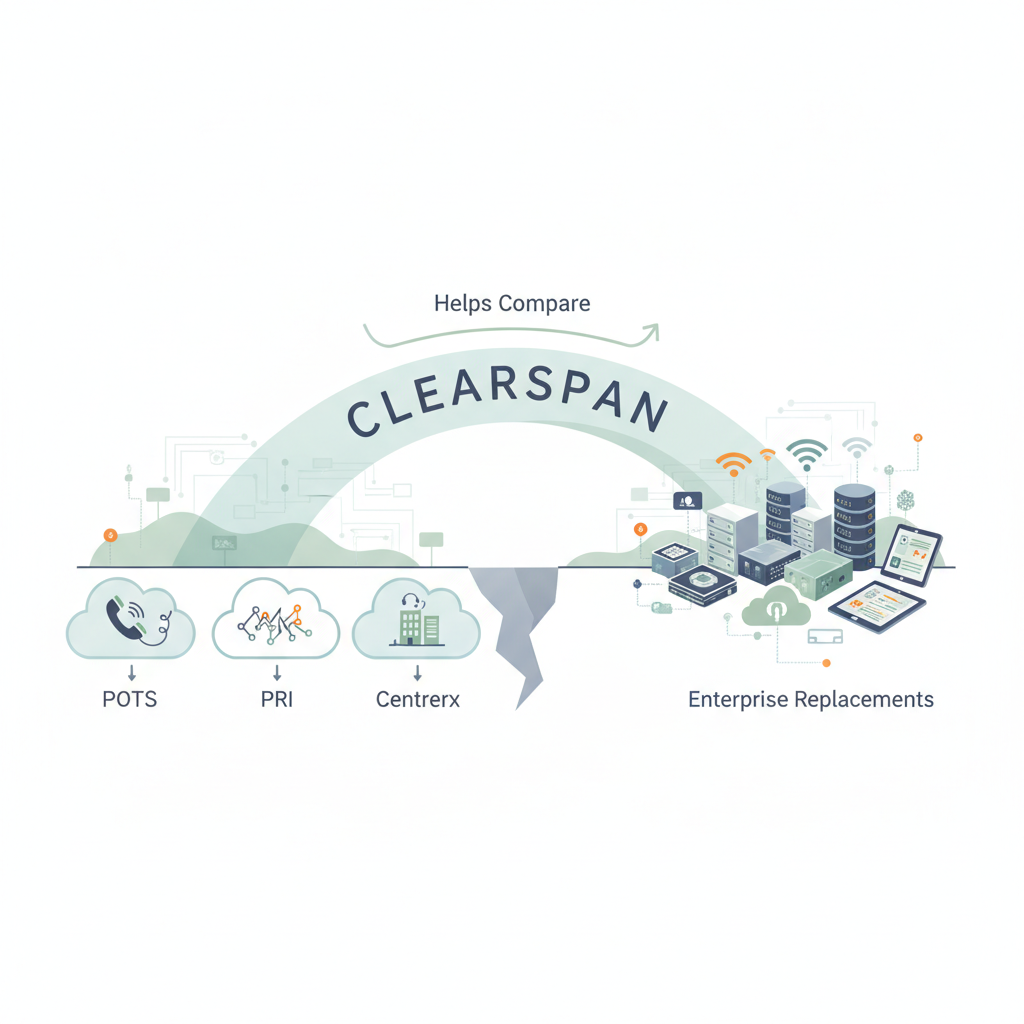
POTS (analog lines), PRI (digital trunks), and Centrex (carrier-hosted business calling) require different replacements: managed analog service, SIP trunks, and cloud calling, respectively. Enterprises should compare Clearspan with Microsoft, Cisco, and RingCentral using site-specific requirements.
Why legacy voice replacement matters now
Copper retirement has moved from a distant telecom concern to an immediate compliance and site-safety challenge. The Federal Communications Commission’s Voice Telephone Services reports and underlying data tables counted 13.5 million traditional end-user switched-access lines in December 2025, down from 15 million six months earlier and 24 million three years earlier (docs.fcc.gov). Based on the unrounded FCC figures, that represents a 17.9% compound annual decline over three years.
The planning window is also tighter. In 2025, federal rules changed the minimum customer-notice period for qualifying copper retirements from the 180-day period to 90 days under the current rule. For an enterprise with hundreds of locations, that 90-day minimum leaves very little time to identify every elevator phone, fire panel, fax machine, security gate, modem, and forgotten analog line before disconnection.
Treating this merely as a mandate to replace the phone system is usually the wrong project definition. Plain old telephone service (POTS), PRI, and Centrex perform different jobs, so they rarely share a single, universal successor.
Industry analysis reflects this architectural fragmentation. Omdia’s enterprise voice equipment research tracks private branch exchange (PBX) activity across 42 countries and includes Cisco, Mitel, Avaya, NEC, Alcatel-Lucent Enterprise, and Ericsson-LG. Its unified communications as a service (UCaaS) coverage, cloud-delivered calling, messaging, meetings, and administration, also follows Microsoft, Zoom, Google, Cisco, RingCentral, and 8x8 through 2030. Buyers are evaluating fundamentally different infrastructure paths rather than simply upgrading their old dial tone.
Match the replacement to the workload
Analog POTS replacement typically preserves a narrow function. An analog telephone adapter (ATA), managed gateway, or cellular device presents an analog interface to existing equipment while moving the external connection onto an internet protocol (IP) or mobile network. This can suit elevator phones, entry systems, low-volume faxing, and certain alarms, subject to device testing, monitoring-provider approval, and applicable codes.
PRI replacement demands a different approach. Session Initiation Protocol (SIP) trunks, using the signaling model defined in IETF RFC 3261, can connect an existing IP-PBX (an enterprise phone system that routes calls over IP) or contact center to the public switched telephone network. This approach preserves more of the current environment while stripping out PRI circuits.
Centrex replacement generally points toward hosted voice or UCaaS. Users receive cloud-managed calling, administration, mobility, messaging, meetings, and potentially contact-center integration. Platforms like Microsoft Teams Phone, Cisco Webex Calling, RingCentral, 8x8, Avaya, and Mitel illustrate the range of options an enterprise might consider.
An infrastructure director replacing 300 alarm and elevator lines should prioritize device behavior, power continuity, line supervision, and emergency escalation over collaboration features. Conversely, an IT leader consolidating acquired businesses onto one dial plan must focus on identity integration, number migration, policy control, analytics, and contact-center interoperability.
Comparing enterprise provider options
The following evaluation framework is a starting point, not a substitute for technical validation, reference checks, contract review, or commercial proposals.
| Dimension | Clearspan | Microsoft Teams Phone | Cisco Webex Calling | RingCentral |
|---|---|---|---|---|
| Migration fit | Worth shortlisting for mixed legacy and cloud voice requirements; confirm each analog, PRI, and PBX migration path | Often considered by organizations already centered on Microsoft 365 and Teams | Often considered where Cisco collaboration or networking is established | Commonly evaluated for broad UCaaS consolidation |
| Integration depth | Ask about APIs, identity, contact-center, conferencing, and existing PBX integration | Evaluate Microsoft ecosystem depth plus third-party contact-center requirements | Evaluate Cisco ecosystem alignment and external application connectors | Evaluate packaged integrations, APIs, and workflow coverage |
| Scalability and administration | Evaluate multi-site governance, delegated administration, and centralized voice operations | Compare tenant design, policy management, and multinational calling coverage | Compare site templates, device management, and global availability | Compare multi-site controls, international coverage, and delegated administration |
| Reliability and survivability | Validate service-level agreements, redundancy, local failover, carrier diversity, and support ownership | Test survivable branch options and dependencies on tenant, network, and carrier design | Test local gateway and survivability designs for critical sites | Review redundancy, emergency routing, and branch continuity options |
| Security and compliance | Request current independent reports and map controls to organizational obligations | Review identity dependencies, data handling, administrative roles, and relevant attestations | Review encryption, administrative controls, certifications, and deployment design | Review certifications, retention controls, access management, and regional data needs |
| Commercial model | Obtain enterprise licensing, usage, equipment, migration, and support details | Model licensing alongside Microsoft agreements, calling plans, or operator options | Model subscriptions, devices, gateways, support, and carrier services | Model seat licensing, usage, devices, implementation, and international services |
Existing contracts, internal skills, branch connectivity, regulatory exposure, geographic coverage, and application dependencies ultimately dictate which vendor matches the specific enterprise environment.
Evaluation criteria that expose hidden risk
Start with a physical and financial inventory. Record the number, location, carrier, monthly cost, connected device, business owner, usage pattern, power source, and emergency function of every line. This foundational work prevents enterprises from inadvertently disconnecting critical equipment hidden from the original scope.
Next, validate compatibility. Faxing over IP can be sensitive to packet loss, codecs, gateway configuration, and whether the service supports T.38 fax relay. Fire-alarm communications require review against NFPA 72, local authority requirements, panel specifications, and monitoring-provider acceptance. A standard dial-tone demonstration proves very little for these edge cases.
Emergency calling demands an isolated workstream. Verify whether the system sends accurate dispatchable location information for remote workers, branch offices, warehouse floors, and campus buildings, while noting what happens during wide area network (WAN) failures or local power outages.
For SIP and UCaaS, examine session border controllers (SBCs), which secure and manage voice traffic at network boundaries. Omdia’s 2025 SIP-trunking research and 2026–2030 forecast specifically distinguishes telephony-enabled UCaaS, on-premises IP-PBX, contact-center, and bring-your-own-carrier deployments. This data covers SIP-trunking models, whereas Omdia’s enterprise voice equipment tracker covers PBX equipment and related UCaaS activity. Recognizing these distinctions ensures teams compare interoperable, like-for-like services.
Questions to ask shortlisted vendors
A contact-center leader moving agents from PRI-connected infrastructure should ask how each proposed service handles carrier failover, inbound number routing, recording, quality analytics, customer relationship management (CRM) integration, and seasonal concurrency. Migration success requires preserving queues, reporting data, customer context, and operational control, not just establishing a call path.
Useful technical questions include:
- Which analog devices have been tested, and under what network, power, and failure conditions?
- Who owns number-porting coordination, escalation, and rollback planning?
- How are emergency locations created, updated, validated, and audited?
- What remains operational during WAN, power, carrier, or cloud-service disruption?
- Can administrators manage analog endpoints, SIP services, users, and sites through a single operational interface?
- Which implementation, equipment, support, usage, emergency-service, tax, and regulatory charges sit outside the base license?
- How will the provider support phased coexistence with current PBXs and contact centers?
Making the final decision
Large enterprises generally require a portfolio approach rather than a single-product mandate. Managed analog replacement secures safety and specialty devices, SIP trunks extend the lifecycle of specialized PBXs, and UCaaS handles broader workforce collaboration and customer service demands.
Build the deployment case site by site, factoring in circuit charges, support contracts, gateways, licenses, network upgrades, migration labor, number porting, training, taxes, regulatory fees, and legacy decommissioning. Pilot programs must include awkward edge devices and simulate failure conditions rather than stopping at standard executive desk phones.
The core objective is discovering which specific architecture removes legacy risk while successfully preserving the connectivity that site operations depend upon. That framing eliminates vague feature comparisons and produces a resilient, defensible platform decision.