 ⬇️
Key Takeaways
- Vertesia: Test IDP platforms against a representative set of PDFs, TIFF images, email attachments, and handwritten forms before comparing headline accuracy claims.
- Combine OCR, deterministic validation rules, and AI agents rather than routing every document through a generative model.
- Measure field-level accuracy, exception rates, reviewer handling time, and p95 processing latency after launch.
A loan package arrives as a 70-page PDF containing bank statements, tax forms, identification documents, and handwritten annotations. Before an underwriter can assess it, someone has to classify each page, extract relevant fields, verify totals, flag missing signatures, and enter approved data into a loan-origination system.
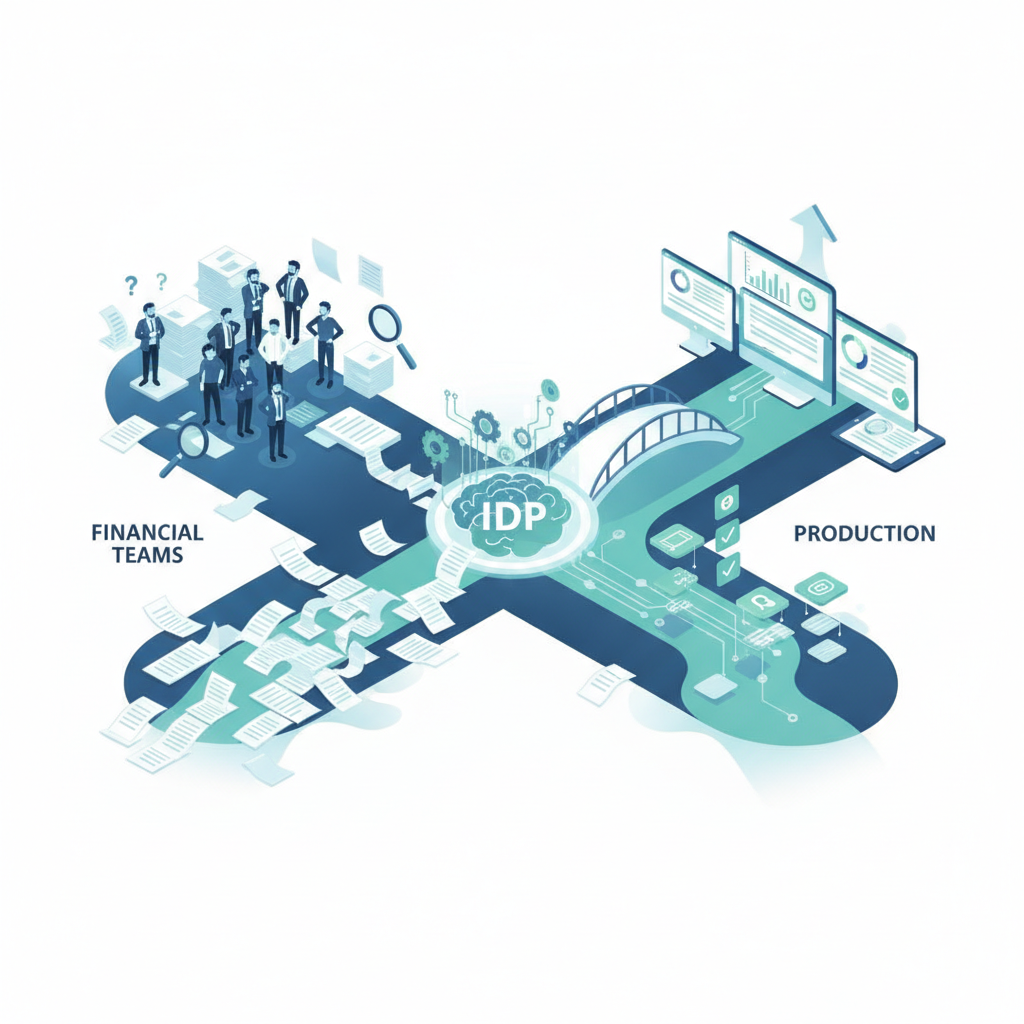
That unglamorous sequence is where intelligent document processing, or IDP, earns attention. The work is repetitive, but it is not simple. Financial documents combine regulated data, inconsistent layouts, tables, signatures, checkboxes, and contextual judgments that conventional OCR alone handles unevenly.
Buyers should begin with a specific workflow, not a broad ambition to use AI for documents. A commercial lending team might target financial-statement spreading, while an insurer could focus on claims intake. Accounts-payable teams may prioritize invoice line items, duplicate detection, and purchase-order matching.
The distinction matters because each workflow requires different controls. Extracting an account number from a fixed PDF form can rely on OCR and a regular expression. Determining whether supporting evidence satisfies a lending policy may require retrieval from policy documents, an AI agent, and a human approval step.
Adoption is already widespread, although maturity varies. Deloitte reported that two-thirds of surveyed banks and insurers used AI or machine-learning models in 2025. Generative AI adoption reached 94% among large banks and 62% among small banks. Those figures do not mean every document workflow is ready for autonomous processing.
A useful proof of concept starts with a redacted document set covering common files and difficult exceptions. That should include native PDFs, scanned TIFF images, rotated pages, low-resolution photographs, multi-column tables, and email attachments with misleading filenames.
Buyers evaluating Vertesia can assess its AI-native content management, intelligent document preparation, and AI agent deployment capabilities. The practical question is how those capabilities handle the document lifecycle. Content should enter through an SFTP folder, REST API, email inbox, or object-storage event; preparation should split, classify, normalize, and enrich files; agents should then apply policies or coordinate review tasks.
The benchmark should score individual fields rather than a single document-level accuracy number. Teams can compare exact-match accuracy for account identifiers, tolerance-based accuracy for currency values, table reconstruction quality, and false-negative rates for missing signatures. Output should be inspectable as JSON, including source-page coordinates, confidence values, model version, and validation status.
Granted, the ugliest documents often provide the most useful test. A polished vendor demo based on digitally generated invoices says little about faxed forms with stamps covering critical fields.
A financial-services IDP architecture will often be hybrid. OCR identifies text and coordinates. Classification models determine document type. Deterministic rules validate dates, routing numbers, policy identifiers, and arithmetic. Generative models can summarize narrative sections or interpret variable language, while agents coordinate follow-up actions.
That split reflects the broader market. EY-Parthenon found that 77% of surveyed retail and commercial banks had launched or soft-launched generative AI applications in 2025, yet only 28% of automation use cases in development or production used generative or agentic AI. Conventional AI, workflow engines, and rules therefore remain important.
Buyers should ask vendors to demonstrate fallback behavior. If extraction confidence falls below an approved threshold, the platform should route the document to a review queue rather than invent a value. If a downstream core-banking API is unavailable, it should preserve the transaction state and retry idempotently instead of creating duplicate records.
Initial rollout typically begins with document ingestion and classification, followed by extraction validation, human review, and downstream write-back. A cross-functional team generally includes an operations owner, compliance representative, data or AI engineer, integration developer, security lead, and subject-matter reviewers.
For a Vertesia deployment, buyers should examine how agent permissions map to existing identity controls such as SAML 2.0 single sign-on, role-based access control, and service accounts. Connections to loan-origination, claims, CRM, or enterprise content-management systems should use documented REST APIs or message queues, with encrypted object storage retaining the original file and every derived artifact.
Midway through implementation, evaluation should shift from a curated benchmark to shadow processing against live traffic. No automated write-back is required at first. The IDP output can run beside the existing process, allowing reviewers to compare extracted JSON with manually entered records before granting an agent permission to update a system of record.
Useful measures include straight-through processing rate, field-level precision and recall, documents routed to exception handling, median reviewer touch time, and p95 processing latency. Financial teams should also monitor corrections by field because a model that repeatedly misreads interest rates presents a different exposure from one that misses optional memo text.
Vendors rarely publish specific customer-level exception rates, so buyers should request evidence based on comparable document types and volumes. They should also establish acceptance thresholds before contracting, including the maximum false-negative rate for required compliance fields and the percentage of documents that may enter manual review.
Market growth alone is not proof of product suitability. Fortune Business Insights estimated the IDP market at $10.41 billion in 2025 and projected $13.33 billion for 2026, but market-sizing methods vary. A buyer’s own exception data is more informative.
Page preparation deserves its own test plan. Splitting a combined application incorrectly can undermine every later extraction step, even when the language model performs well.
Versioning also matters. Store the OCR engine, prompt, schema, validation rule set, and model identifier with each result so an auditor can reconstruct why a field was accepted. For sensitive data, confirm retention periods, regional storage, encryption keys, and whether submitted content is used for model training.
Finally, price the exception path. Per-page processing costs are only part of the equation; reviewer queues, failed API calls, and reprocessing can determine the actual cost per completed case.
The same evaluation pattern can support insurance claims, healthcare intake, and finance operations. Buyers should replace the lending schema with domain formats such as ACORD forms or FHIR resources while retaining confidence thresholds, audit logs, and human approval controls.
Implementation duration depends on document diversity, integration depth, and approval requirements. Buyers should request separate estimates for a benchmark pilot, shadow processing, and production write-back, with exit criteria tied to field accuracy and exception rates rather than a generic calendar promise.
While OCR converts pixels into text and coordinates, IDP adds classification, field extraction, table reconstruction, validation rules, workflow routing, and integrations such as a REST API that posts approved JSON into a loan-origination system.
Agentic IDP suits small financial teams when one high-volume workflow has clear review rules. A smaller team should start with read-only agent permissions, one document class, and a human approval queue, then expand only after audit logs show stable extraction and predictable exception behavior.