 ⬇️
Key Takeaways
- Genesis AI raised a $500 million Series A at a reported $3.5 billion post-money valuation, bringing its disclosed funding since 2024 to $605 million.
- Data from sensor-equipped gloves and headset cameras feeds a full-stack system spanning the GENE model, Genesis World simulator, and Eno robot.
- Early deployments will test whether Genesis AI can improve hand durability, task repeatability, safety, and manufacturing capacity ahead of a broader 2027 rollout.
Genesis AI has raised $500 million in Series A funding to expand an ambitious physical-AI platform built around human demonstrations, simulation, robotics models, and dexterous hardware. The financing values Genesis AI at a reported $3.5 billion post-money and takes its disclosed funding since 2024 to $605 million, according to coverage from TechCrunch and Crunchbase News.
The size of the round stands out, particularly for a business still moving from prototypes into limited customer pilots. It reflects investor appetite for physical AI, but it also gives Genesis AI the capital required for an unusually broad strategy. Rather than concentrating exclusively on robot hardware or foundation models, Genesis AI is developing the data-collection tools, simulation environment, AI model, and finished robotic system together.
Its training pipeline begins with people performing real work. More than 100 workers worldwide reportedly wear sensor-enabled gloves and headset cameras that capture movement, visual context, dexterity, and force. Those demonstrations provide information that conventional video alone may not reveal, such as how firmly a person grips an object or how pressure changes during manipulation.
That distinction matters. Picking up a rigid box is relatively straightforward. Handling flexible packaging, laboratory equipment, cables, or objects with inconsistent shapes is another matter entirely. Small errors in force or finger positioning can turn an impressive demonstration into an unreliable production process.
The collected data supports GENE, Genesis AI's robotics model, while Genesis World provides a simulated environment for training and testing. Eno, the company's general-purpose robot, is the physical endpoint. Genesis AI has built between 30 and 40 Enos and is piloting them with a handful of customers whose names have not been disclosed.
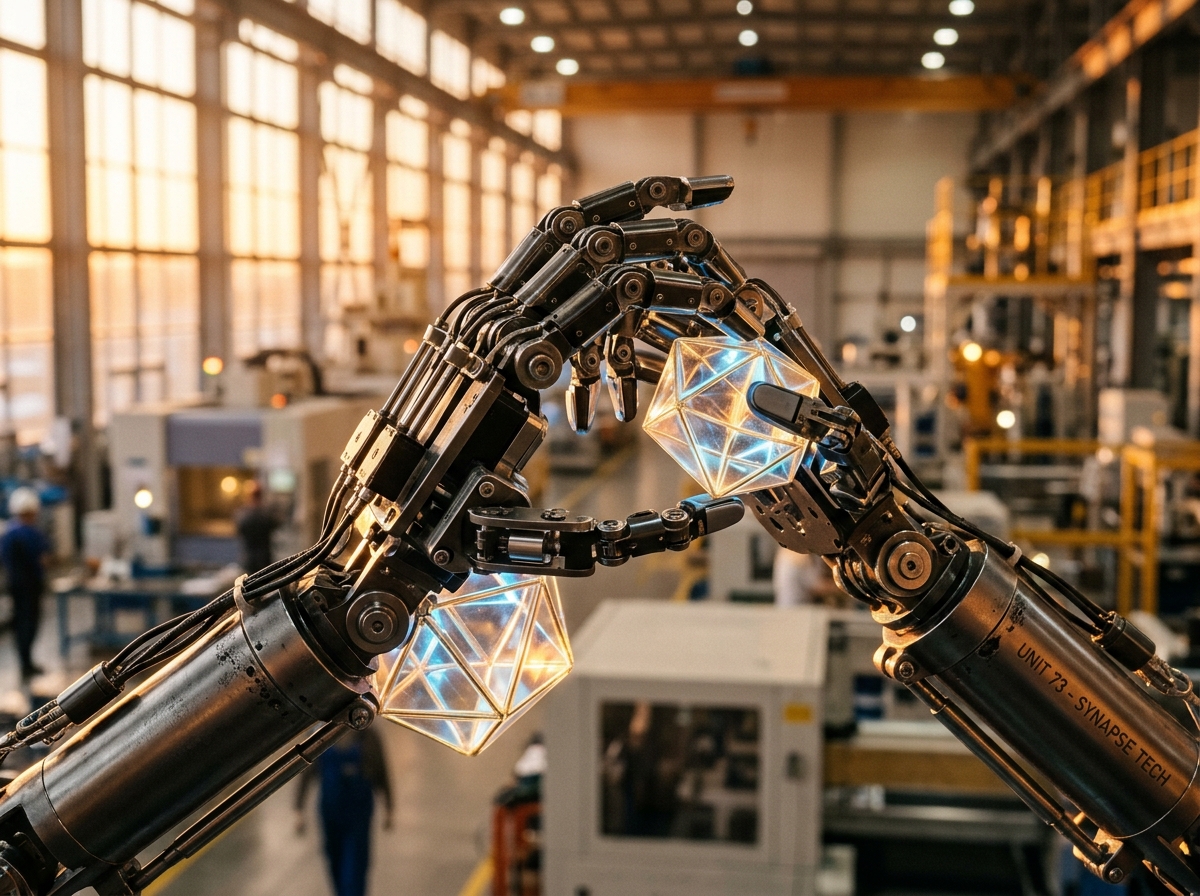
Each Eno hand has 20 actuated degrees of freedom, according to Genesis AI. That level of articulation could support tasks that are difficult to automate with fixed grippers. Forbes also highlighted the company's effort to pursue more human-like robotic hands, an area that has become central to the race for adaptable industrial machines.
Dexterity in a controlled demonstration is not the same as dependable performance across thousands of shifts. TechCrunch observed limitations in task repeatability, and Eno's hands reportedly need replacement after only a few weeks of regular work. For factory and warehouse operators, those details can affect uptime, maintenance staffing, spare-parts inventory, and the eventual cost per completed task.
Can a highly articulated hand remain economical if its most complex components wear out quickly? The new funding gives Genesis AI room to work on that question, but customer deployments will provide the more meaningful evidence.
The company's initial focus covers manufacturing, logistics, and laboratories. That puts Genesis AI into competition not only with humanoid developers such as Figure and Agility, but also with established industrial automation suppliers including ABB and FANUC. Incumbents already have deep integration experience, service networks, and familiarity with production requirements. Genesis AI is betting that a more adaptable learning system can address variable tasks that traditional automation often handles poorly.
Safety will be part of the commercial equation. Industrial deployments may be assessed against ISO 10218-1/-2:2025, while collaborative applications can also draw on ISO/TS 15066:2016. Compliance alone does not establish a business case, but it can shape cell design, operating speeds, risk assessments, and how closely robots are permitted to work alongside people.
That said, software capability may not be the main bottleneck during the next phase. Genesis AI plans to begin U.S. manufacturing and pursue a broader rollout in 2027. Reaching that point will depend on component sourcing, quality control, repairability, and consistent output across a larger robot fleet.
The $500 million Series A therefore buys more than additional model training. It gives Genesis AI time and resources to turn a technically compelling data strategy into durable machinery. The pilots now underway should indicate whether glove-captured human skills can translate into repeatable, safe, and economically useful work outside a robotics lab.