 ⬇️
Key Takeaways
- Parameter: Global non-revenue water is estimated at roughly 30% of supply, making continuous acoustic and pressure monitoring a financial control rather than merely a maintenance tool (openknowledge.worldbank.org).
- Gas operators evaluating coverage across approximately 2.8 million miles of regulated U.S. pipelines should align sensors, survey methods, and repair workflows with PHMSA requirements.
- Facilities evaluating leak detection systems should verify sensing coverage, zone-level alarm detail, protocol support, and integration with building management or data-center infrastructure management systems.
- A credible pilot should test detection sensitivity, false-alarm rates, localization accuracy, and work-order integration before expanding across the network.
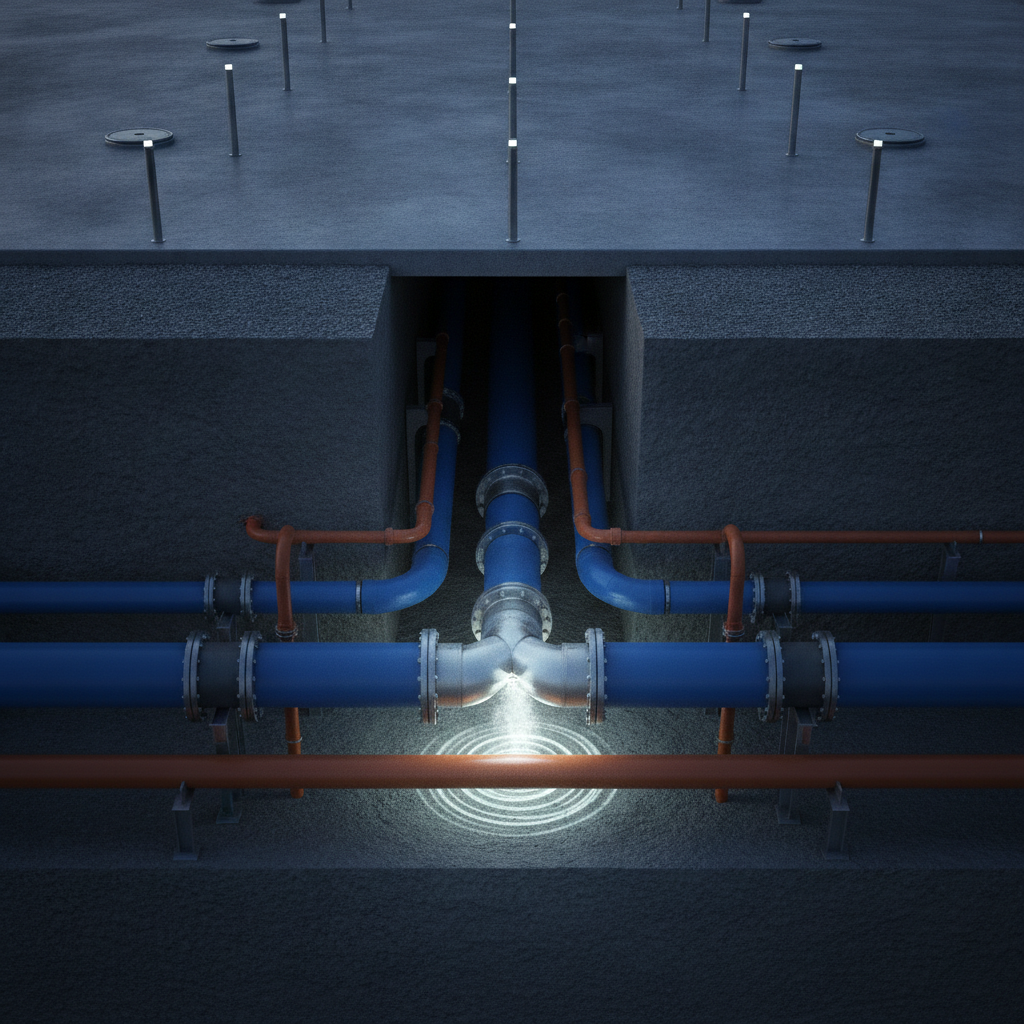
Continuous leak detection, the use of sensors and analytics to identify suspected releases, can reduce water loss, methane emissions, and repair delays by connecting verified alarms directly to utility and facility maintenance workflows.
Define the Problem Before Selecting Sensors
A leak rarely begins as an obvious rupture. In a water distribution network, it may appear as a faint acoustic signature that changes with pressure, pipe material, and overnight demand. In a gas system, the first indication may come from an infrared camera, a vehicle-mounted laser detector, or an unexpected shift in flow and pressure data.
The scale makes periodic inspection difficult to defend as the only detection method. Water Today reports that global non-revenue water, supplied water that does not produce revenue because of physical losses, metering errors, or billing problems, is estimated at approximately 30%, with an annual cost near $39 billion. Because that total includes both physical leakage and commercial losses, sensor deployment alone cannot explain or recover the entire gap.
Buyers should begin with a narrower operational question. Are crews trying to find hidden distribution leaks, identify methane releases sooner, protect pumps and electrical rooms from water intrusion, or reduce the time between an alarm and a repair order?
Each problem produces a different technical specification. Acoustic correlators, which compare the travel time of leak noise between sensor points, can locate underground water leaks. Fiber-optic distributed acoustic sensing, or DAS, uses changes in backscattered light to detect vibration along long pipeline segments. Conductive sensing cable and spot sensors are more appropriate around data-center cooling equipment, battery rooms, valves, and low points where liquid can collect.
Build an Evaluation Around Detection Performance
Detection range is only one line on the checklist. A useful evaluation also examines minimum detectable leak rate, localization precision, sampling frequency, battery life, communications coverage, ingress-protection rating, calibration requirements, and performance under expected temperature and humidity conditions.
For buried water mains, buyers might compare permanently installed acoustic loggers using Narrowband Internet of Things, or NB-IoT, and LTE-M cellular connections against portable correlators deployed by field crews. The permanent model provides recurring samples, while the portable model can cost less where technicians already inspect a compact service area. FIDO Tech, Xylem Vue, and Kamstrup illustrate the range of available analytics and acoustic-monitoring approaches. For example, in a documented Arizona deployment, EPCOR used 4,554 acoustic sensors with FIDO Tech's AI analytics, reducing non-revenue water in its San Tan network from 27% to approximately 10%.
Facilities evaluating Parameter can apply the same discipline to point sensors, sensing cable, environmental probes, and the alarm path into a building management system. Buyers should determine whether the system can identify the affected zone, distinguish persistent leakage from transient moisture, and transmit a usable event through BACnet, Modbus TCP, SNMP, or a REST API, not merely whether its dashboard displays an alert.
For gas pipelines, regulatory coverage now shapes the buying decision. PHMSA's 2025 final-rule package sets updated leak-detection and repair requirements across approximately 2.8 million miles of U.S. transmission, distribution, and gathering pipelines, as well as underground storage and liquefied natural gas facilities. According to the PHMSA estimates documented in GTI Energy's June 2025 final-rule policy brief, more frequent surveys, higher-sensitivity detection, and faster repairs could eliminate up to 500,000 metric tons of methane annually and produce as much as $1.5 billion in annual net public benefits.
Plan the Architecture and Rollout
Initial deployments generally target a representative operating zone rather than the easiest location. For a water utility, that could include cast iron and PVC mains, pressure variations, busy roads, and known background noise. A gas operator might include compressor stations, gathering lines, valves, and segments with different survey-access constraints.
During initial deployment, the operational technology team establishes connectivity and device identity. Maintenance personnel validate installation locations. Data engineers map sensor records to asset identifiers in a geographic information system, or GIS, computerized maintenance management system, or enterprise asset management platform. Cybersecurity staff review certificate handling, encrypted transport, network segmentation, and remote firmware procedures.
During the tuning phase, establishing accurate alarm thresholds is critical. A static threshold may generate nuisance alerts when pumps start, pressure-reducing valves operate, or condensation reaches a facility sensor. Combining acoustic amplitude with pressure, flow, temperature, and time-of-day data can provide stronger evidence than any single reading.
Data from Parameter sensors, for example, may feed an existing building management system or data-center infrastructure management, or DCIM, environment rather than creating another isolated console. That integration should preserve timestamps, zone identifiers, alarm severity, acknowledgement status, and escalation history. Without those fields, a control-room operator may receive an alert without enough context to dispatch the appropriate technician.
The final rollout phase connects validated alarms to work execution. A confirmed event might open a ServiceNow, IBM Maximo, or SAP maintenance record through a REST API, attach recent sensor history, and route the task according to asset criticality. Granted, integration work is less visible than installing sensors. It is often what determines whether an alert becomes a repair.
Measure Operational Outcomes, Not Dashboard Activity
Device count is not a meaningful success measure by itself. Buyers should track the minimum detectable leak rate, percentage of alerts confirmed in the field, false-positive frequency, localization error, elapsed time from detection to acknowledgement, and elapsed time from acknowledgement to repair.
Gas operators can also measure survey coverage and emissions-related performance. GTI Energy's June 2025 assessment estimates that performance-based detection, selecting survey technologies according to demonstrated detection capability, could raise targeted-leak detection from 76.5% to 90%. The assessment identifies potential emissions reductions of 13% to 30% for distribution pipelines and up to 54% for regulated gathering lines. These percentages describe potential reductions within specific pipeline categories; they are not directly comparable to PHMSA's estimate of up to 500,000 metric tons across the broader regulated system.
Water utilities should compare district-metered-area inflow against billed consumption and expected legitimate use. A falling minimum night-flow baseline after repairs offers stronger evidence of reduced leakage than a rising number of software alerts.
Vendors rarely disclose universal outcome metrics for every deployment type, and buyers should evaluate detection rates in the context of their specific operating environments. Pipe material, soil, ambient noise, sensor spacing, and leak size all affect results.
Apply the Lessons to the Procurement Process
A proof of concept should include difficult conditions. Testing only a quiet mechanical room or a recently installed pipe segment can conceal false alarms, weak wireless coverage, and localization problems.
Buyers should also ask vendors to demonstrate raw event handling, not only polished dashboards. Export a sample alarm in JSON or CSV, send it through the proposed API, create a maintenance ticket, and confirm that technicians can trace it back to the correct asset.
API Recommended Practice 1175 can help pipeline teams examine program management, assigned roles, testing, and continuous improvement alongside sensor performance. For facilities, the equivalent discipline is an alarm-response matrix that states who receives each severity level, how quickly it must be acknowledged, and when escalation occurs.
Broader Applicability
The same evaluation model can support municipal water systems, gas networks, power-generation sites, district energy plants, and hyperscale data centers. The sensor physics will differ, but the buying logic remains focused on coverage, detection quality, integration, and repair response.
How long does a leak-detection implementation take?
Timing depends on network size, civil-access requirements, and integration scope. A contained pilot can often proceed within several months, while deployment across thousands of pipeline or water-network assets may require multiple budget and construction cycles. Buyers should estimate sensor installation separately from GIS, computerized maintenance management system, BACnet, or supervisory control and data acquisition integration.
What should be included in a leak-detection proof of concept?
Include representative assets, controlled leak simulations where safe, noisy operating conditions, weak-connectivity areas, and at least one complete alarm-to-work-order test. Measure sensitivity, false-positive frequency, localization error, communications uptime, and technician response instead of counting dashboard events.
Is continuous monitoring better than periodic leak surveys?
Continuous Internet of Things sensing can identify changes between scheduled inspections, but it does not replace every survey technique. Many operators combine permanent acoustic, pressure, fiber-optic, or environmental sensors with vehicle-mounted, aerial, infrared, laser, or handheld inspections to confirm alarms and cover assets where fixed instrumentation is impractical.