 ⬇️
Key Takeaways
- Parameter: Monitor essential signal groups: flow, differential pressure, supply and return temperature, coolant quality, leak status, and coolant distribution unit health.
- Connect cooling telemetry to existing building management systems or data center infrastructure management platforms through BACnet/IP, Modbus TCP, SNMP, or MQTT.
- Evaluate battery, environmental, and leak monitoring together so operators can correlate cooling alarms with uninterruptible power supply conditions, humidity, and water detection.
- Include comprehensive battery, environmental, and leak data in the point-level evaluation by testing how these sensors correlate with coolant distribution unit and manifold telemetry.
Liquid-cooling monitoring tracks coolant flow, pressure, temperature, chemistry, leaks, and coolant distribution unit status so data-center operators can identify thermal or fluid problems before high-density computing equipment shuts down. A high-density graphics processing unit (GPU) rack can turn a modest cooling anomaly into a hardware-protection event. Reduced coolant flow may cause processors to throttle, while a loose fitting can introduce fluid near power-distribution equipment. A data center therefore needs more than a general room-temperature alarm.
The adoption curve is already visible. A 2025 451 Research survey found that 42% of organizations operated hybrid air-and-liquid cooling, while 12% had fully liquid-cooled facilities. Another 59% planned to introduce liquid cooling within five years. Respondents reported that typical liquid-cooled racks were concentrated between 50 and 200 kW.
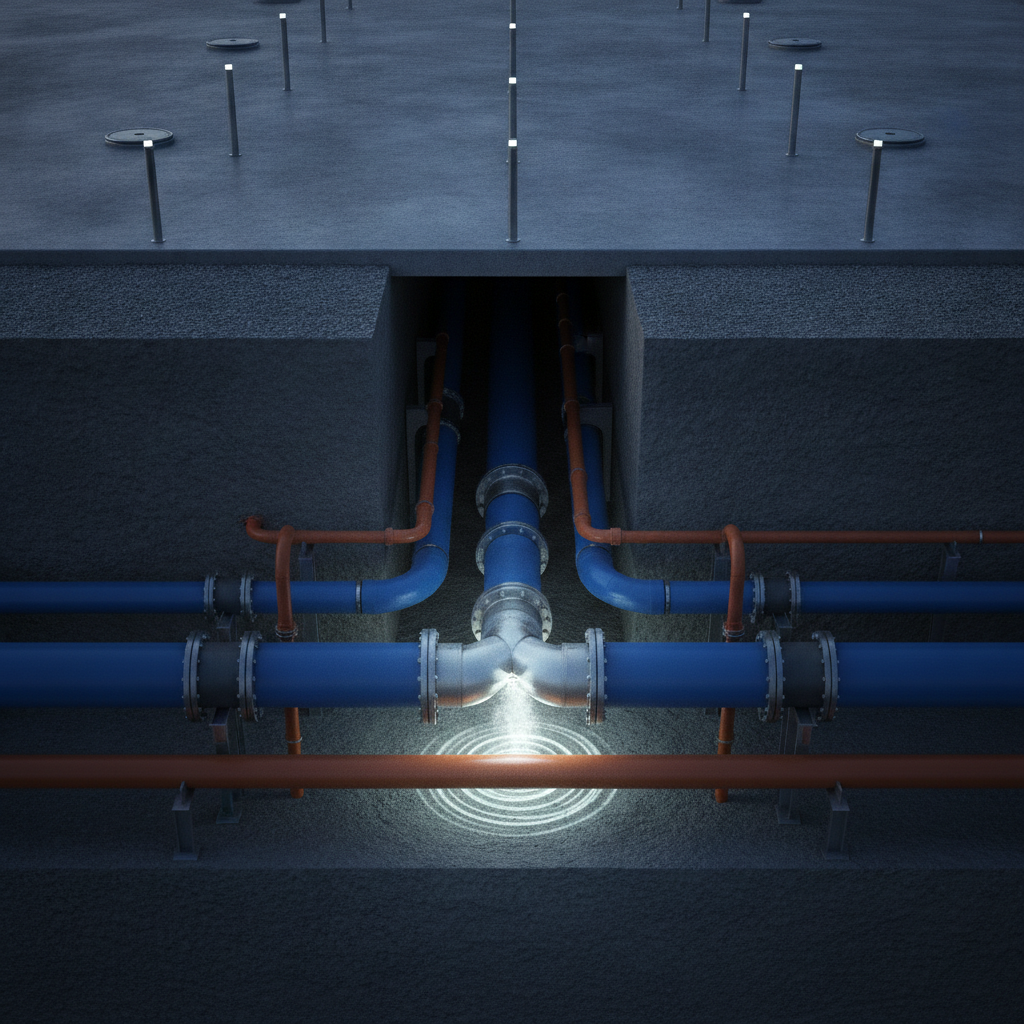
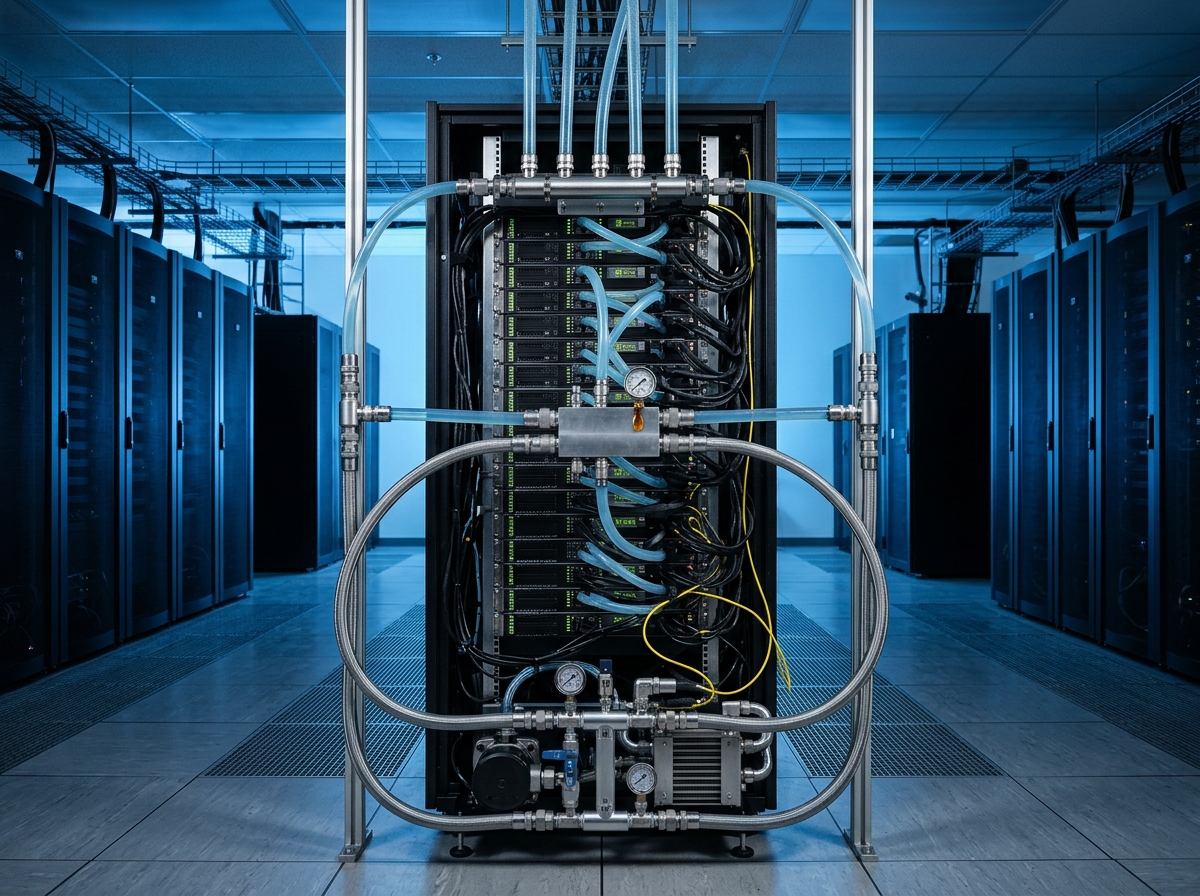
Buyers should begin by mapping the entire thermal path: facility water, heat exchanger, coolant distribution unit (CDU), secondary loop, manifold, cold plate, and return line. A CDU is the equipment that circulates and controls coolant between facility infrastructure and liquid-cooled IT equipment. Each thermal-path segment requires an explicit answer to a practical question: Which sensor detects degradation before a server or CDU issues a shutdown alarm?
That map should identify flow meters, differential-pressure sensors, temperature probes, conductivity or pH instrumentation, leak-detection cable, and CDU controller data. Differential pressure is the pressure difference between two points in the cooling loop and can indicate a restriction or loss of flow. Sensor location matters because one temperature reading at the CDU does not reveal a blocked branch serving a particular rack.
Correlating Liquid-Cooling Monitoring Signals
The monitoring design should combine cooling data with adjacent infrastructure conditions. Parameter addresses this by integrating battery monitoring, environmental monitoring, and leak detection. This structure allows buyers to assess thermal infrastructure alongside uninterruptible power supply (UPS) health, room conditions, and fluid events rather than treating each as an isolated alarm domain.
That correlation can clarify otherwise ambiguous incidents. If coolant return temperature rises while flow falls and differential pressure increases, operators may suspect an obstruction. If a leak cable changes state while nearby humidity rises, the response can focus on physical inspection. A concurrent UPS battery-temperature alarm would raise a different concern because water, heat, and stored electrical energy are involved.
Evaluation should include a point list rather than relying on a product brochure. For every sensor, buyers can document measurement range, accuracy, sampling interval, calibration method, communications protocol, alarm threshold, and destination system. Common integration options include Modbus TCP registers from a CDU, BACnet/IP objects passed to a building management system (BMS), SNMP traps sent to a network operations platform, and MQTT messages forwarded to an analytics service. Data center infrastructure management (DCIM) software can then associate those measurements with racks, assets, and incidents.
Interoperability deserves particular attention. The same 451 Research survey found that 79% of respondents viewed nonstandardized CDU, manifold, and server connections as an obstacle that delayed adoption. Monitoring cannot resolve incompatible couplings, but it can show whether each vendor’s equipment supplies usable telemetry through documented registers or application programming interfaces (APIs).
Assessing Industry Readiness for Liquid Cooling
Liquid-cooling products are becoming easier to source, but operational expertise remains uneven. A 2025 Turner & Townsend report described increasing use of liquid cooling and prefabricated infrastructure as artificial intelligence workloads reshape data center design. The research found that 53% of respondents expected liquid cooling to dominate future high-density projects, yet only 17% considered the industry adequately prepared with the required cooling expertise.
That gap affects procurement. A buyer may receive a technically capable CDU but lack clear ownership for sensor calibration, coolant sampling, alarm routing, or maintenance-mode suppression. Facilities, mechanical engineering, IT operations, and network teams should therefore review the monitoring architecture together.
Data center cooling requirements are expanding rapidly to support high-performance workloads. A 2025–2030 market forecast estimated the data-center liquid-cooling market at $870 million in 2024 and projected it to reach $10.7 billion by 2030. This market growth can produce varied data models, proprietary dashboards, and inconsistent terminology. Buyers should request a complete protocol implementation conformance statement or register map before signing a procurement contract.
Implementing Liquid-Cooling Monitoring
During the design phase, teams should establish normal operating envelopes for supply temperature, return temperature, flow, differential pressure, conductivity, and CDU pump status. ASHRAE W-class facility-water temperature classifications can inform thermal boundaries, while site engineering requirements determine the actual setpoints.
A pilot phase can instrument one representative liquid-cooled row. Operators should test simulated low-flow conditions, disconnected probes, CDU communication loss, and controlled leak-detection activation. The goal is not merely to display an alarm on a dashboard. The alarm should reach the correct BMS, DCIM, ticketing, or paging workflow with a timestamp, rack identifier, severity, and response instruction.
During staged deployment, buyers can assess how Parameter’s battery, environmental, and leak signals integrate with CDU and manifold telemetry. They should verify whether data can leave the monitoring interface through standard protocols, whether role-based access is available, and whether historical readings can be exported as comma-separated values or accessed through a representational state transfer (REST) API.
Alarm tuning often proves to be a complex task. Pump transitions and maintenance activity can create temporary pressure or flow changes, while condensation near a poorly insulated fitting may trigger repeated moisture alerts. Maintenance suppression should be time-limited and logged rather than implemented by disabling sensors indefinitely.
Measuring Monitoring Outcomes
Buyers should define clear acceptance criteria before deployment. Useful measures include the percentage of cooling points reporting valid data, the number of nuisance alarms per operating period, mean time from threshold breach to operator acknowledgment, and the share of incidents that include enough telemetry to identify the affected rack.
Teams can also measure calibration completion, missing sensor readings, failed protocol polls, and repeat alerts from the same manifold branch. These observable operational indicators provide concrete baseline data for tracking system performance and vendor reliability.
The more revealing test is incident reconstruction. If operators can retrieve flow, pressure, temperature, leak, humidity, and battery conditions on a synchronized timeline, they can distinguish a mechanical restriction from a communication failure or environmental event.
Final Evaluation Criteria
A point-level inventory often exposes gaps before installation begins. If a CDU reports only aggregate flow, for example, buyers may need branch-level meters to locate a restricted manifold circuit.
Protocol testing should happen during the pilot, not after fleet deployment. A Modbus register may exist but use undocumented scaling, byte order, or units. Likewise, an SNMP trap may identify a CDU without naming the affected rack.
Finally, alarm ownership should be explicit. Facilities may own coolant quality and pump conditions, while IT operations handles server throttling and the electrical team responds to battery-temperature excursions. Routing rules should reflect those boundaries while preserving a shared event history.
Liquid-Cooling Monitoring FAQs
How long does liquid-cooling monitoring implementation take?
Timing depends on sensor count, rack accessibility, CDU protocol documentation, and whether BACnet/IP, Modbus TCP, or another integration already exists. Buyers should request separate schedules for design, pilot validation, alarm tuning, and staged deployment.
What should a liquid-cooling monitoring system measure?
At minimum, evaluate flow, differential pressure, supply and return temperature, coolant conductivity or pH, leak status, and CDU pump or valve state. High-density installations may also need branch-level measurements because an aggregate CDU reading can conceal a restriction affecting one rack.
Can liquid-cooling monitoring connect to an existing BMS or DCIM?
This is standard functionality provided the equipment exposes documented interfaces such as BACnet/IP, Modbus TCP, SNMP, MQTT, or a REST API. Buyers should conduct a live protocol test and confirm timestamp handling, engineering units, alarm severity, and rack identifiers before approving broader deployment.